
Putting patients at the center of smarter trial design
Find out how Trial Sergeant helps research teams identify and minimize patient burden to improve recruitment and retention
What We Do
Trial Sergeant provides a platform that helps sponsors, CROs, and research teams understand and improve patient burden and its impact on their trial designs.
Through structured data inputs and built-in analytics, we translate complex trial protocols into clear, actionable insights: from patient burden to optimization opportunities.
Our tools give your team the visibility needed to design trials that work better for patients.

We provide the visibility needed to design trials that work better for patients

Quantify and compare patient burden across study arms or protocols

Visualize procedures, visits and timelines

Forecast recruitment delays linked to participant workload

Identify design adjustments that reduce time and patient burden

How Trial Sergeant Works
01
Input Your Trial Schedule
Start by entering your trial schedule, including procedures, visit structure, and frequency. The platform supports flexible inputs for both cycled and visit-based designs.
02
Analyze Patient Burden
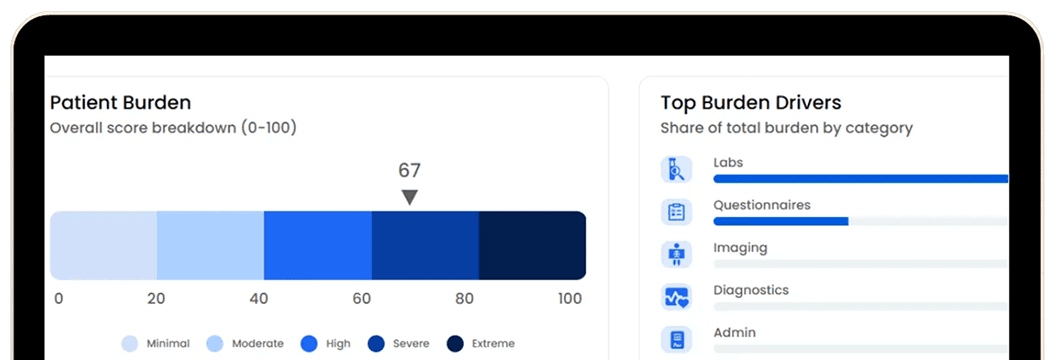
Trial Sergeant automatically calculates the burden placed on participants
based on procedure intensity, frequency, and visit load.
This yields a Burden Score (0-100), bench-marked against thousands of
real-world trial designs.
03
Visualize and Compare
Get instant dashboards that show how your trial performs across key dimensions: patient burden, visit efficiency, procedure mix, and site workload. Easily compare against SOC or alternate trial arms.
04
Project Recruitment Timelines
Our recruitment engine models how patient burden impacts enrollment speed. It estimates potential recruitment delays so you can plan proactively.

Why Patient Burden Matters
Clinical trials are complex, but the path to efficiency doesn’t have to be.
By integrating operational analytics early in the design phase, Trial Sergeant helps teams design studies that are both scientifically sound and logistically achievable.
Every percentage point of reduced burden means faster recruitment, better retention, and more meaningful patient participation.